Behind every experiment: hidden research infrastructure
Choosing a word or a picture for an experiment sounds like a small and easy task. However, in psycholinguistic research, every stimulus can be characterised by several properties at once: how familiar it is, how consistently it is named, how readily its referent can be imagined, and when its meaning tends to be learned.
None of these properties are neutral. Differences among them can influence how quickly or accurately people respond to a stimulus, even when those properties are not the focus of the experiment. Psycholinguistic norms provide standardised reference values that allow researchers to select, match, and interpret their materials more carefully. They are therefore part of the measurement infrastructure of an experiment, rather than an optional addition made after the design is decided upon.
Thai has historically had far fewer of these resources than English and other widely studied languages. As a consequence, developing Thai-specific norms, stimuli, and behavioural measures has become a central strand of my research and of the Cognitive and Language Processing (CLP) Lab.
The aim of this article is to explain why these dedicated resources are needed, why translation alone cannot solve the problem, what psycholinguistic norms measure, how the current resources connect, and what behavioural studies reveal about their value.
Why translation is insufficient
The same photograph can be used in studies conducted in different languages, but it cannot simply be assumed to have the same normative values across different populations. An image of a hammer may appear in experiments conducted in English, French, or Thai, yet the name it elicits, its familiarity, and the age at which the concept it represents tends to be learned depend on the population providing the data.
The Thai standardisation of the Bank of Standardized Stimuli (BOSS) illustrates this distinction. Clarke and Ludington (2018) collected normative data from Thai participants for all 480 photographs. They then compared the Thai values with the existing English and French norms for the variables shared across the three datasets. The resulting item-level correlations showed that several dimensions retained a similar structure across languages. Visual complexity ratings, for example, correlated strongly across the three datasets.
At the same time, the absolute values were not interchangeable. Mean object-familiarity ratings were lower for the Thai sample (3.51) than for the English (4.07) and French (4.13) samples. Clarke and Ludington (2018) also reported that Thai name agreement was closely comparable with the original English and French BOSS norms after pictures that were frequently not recognised by Thai participants were excluded. This supported the interpretation that cultural unfamiliarity with some objects contributed to the higher rate of naming failures in the full Thai dataset. An object that elicits one dominant name in one language may still invite several alternatives in another.
The practical point is that cross-language convergence does not make the normative values interchangeable. The same underlying psycholinguistic constructs can often be measured across languages, but this does not mean that the same numerical values apply everywhere. For written words, the need for direct measurement is even clearer because Thai has its own script, a tonal lexical system, and language-specific patterns of word form and naming.
Translating or reusing a stimulus across languages does not transfer the evidence needed to characterise it for behavioural research with a new population.
What psycholinguistic norms actually measure
Psycholinguistic norms are standardised item-level values derived from systematic data collection. Many norms are based on ratings, but they may also be obtained from naming responses, response times, corpus counts, textbook occurrences, or measurements calculated from word forms. They are not fixed properties inherent in any word or picture. They describe how an item is characterised within a defined sample, task, or source.
The measures used in Thai psycholinguistic research can be organised into four broad groups:
Lexical form and learning history: the length of a word, how frequently it is encountered, when it tends to be learned, and how it relates orthographically or phonologically to other words.
Semantic and sensorimotor properties: how easily a word evokes a mental image (imageability), how concrete or abstract a word is, and the perceived ease of physically interacting with its referent (body-object interaction, or BOI). The words rope and cloud, for example, can both be easily imagined, although their referents differ substantially in the degree of bodily interaction they afford.
Object and picture properties: how familiar an object is, how closely a photograph matches the mental image generated by an object’s name, how visually complex the photograph appears, and how easily the object can be physically grasped or its typical use communicated through mime.
Response-derived measures: how participants respond to an item, including the response they produce, how consistently it is produced, and how quickly it is initiated. Examples include name agreement, picture-naming latency, and mime initiation latency.
A useful distinction to make here is between a task, an observation, and a norm. Picture naming is a task; one participant’s response is an observation; and an aggregated and documented item-level value, such as name agreement or picture-naming latency, can become a norm. The same applies to rating tasks and to mime initiation latency (MIL).
A behavioural measure can therefore become a norm when it is collected systematically across items and made interpretable for reuse.
A reusable research resource therefore consists of more than a spreadsheet of item-level values. It should identify the stimuli and items, define each variable, document how the data were collected and aggregated, describe the sample and procedure, report reliability or other quality checks where relevant, and provide clear information about access, reuse, and citation.
These elements allow other researchers to interpret the values correctly, evaluate their suitability for a particular study, and apply them consistently.
Building connected psycholinguistic resources for Thai
The Thai psycholinguistic resource-development programme began with pictures. Its foundational study established Thai norms for 480 high-resolution colour photographs from the Bank of Standardized Stimuli (BOSS). A total of 584 Thai university students provided data across eight dimensions: name agreement, object familiarity, visual complexity, category agreement, image agreement, rated age of acquisition, graspability, and mimeability (Clarke & Ludington, 2018).
The programme subsequently expanded from object photographs to written words. A lexical-norming study currently under review includes 627 Thai words: 430 object names corresponding to photographs in the earlier picture resource, together with additional concrete items and a set of abstract words. A total of 106 Thai university students rated the words for imageability, BOI, and subjective frequency. Including abstract words extended the resource beyond concepts that can be represented directly in photographs and broadened its coverage, particularly towards the lower end of the imageability scale.
A broader working lexical set contains 665 items. Once the additional data have been consolidated, the lexical resource is expected to expand accordingly.
The value of the programme lies in the connections among these resources. Overlapping items and shared identifiers allow information about photographs, object concepts, and written words to be linked. Researchers can therefore examine multiple properties of the same item rather than treating each dataset as an isolated endpoint. The CLP Lab provides a framework for documenting, extending, and preparing these connected resources for reuse.
Thai words & pictures
Grouped norms
lexical · semanticobject · response-derived
Behavioural tasks
naming · miming · categorisingReusable resources
datasets · measures · evidence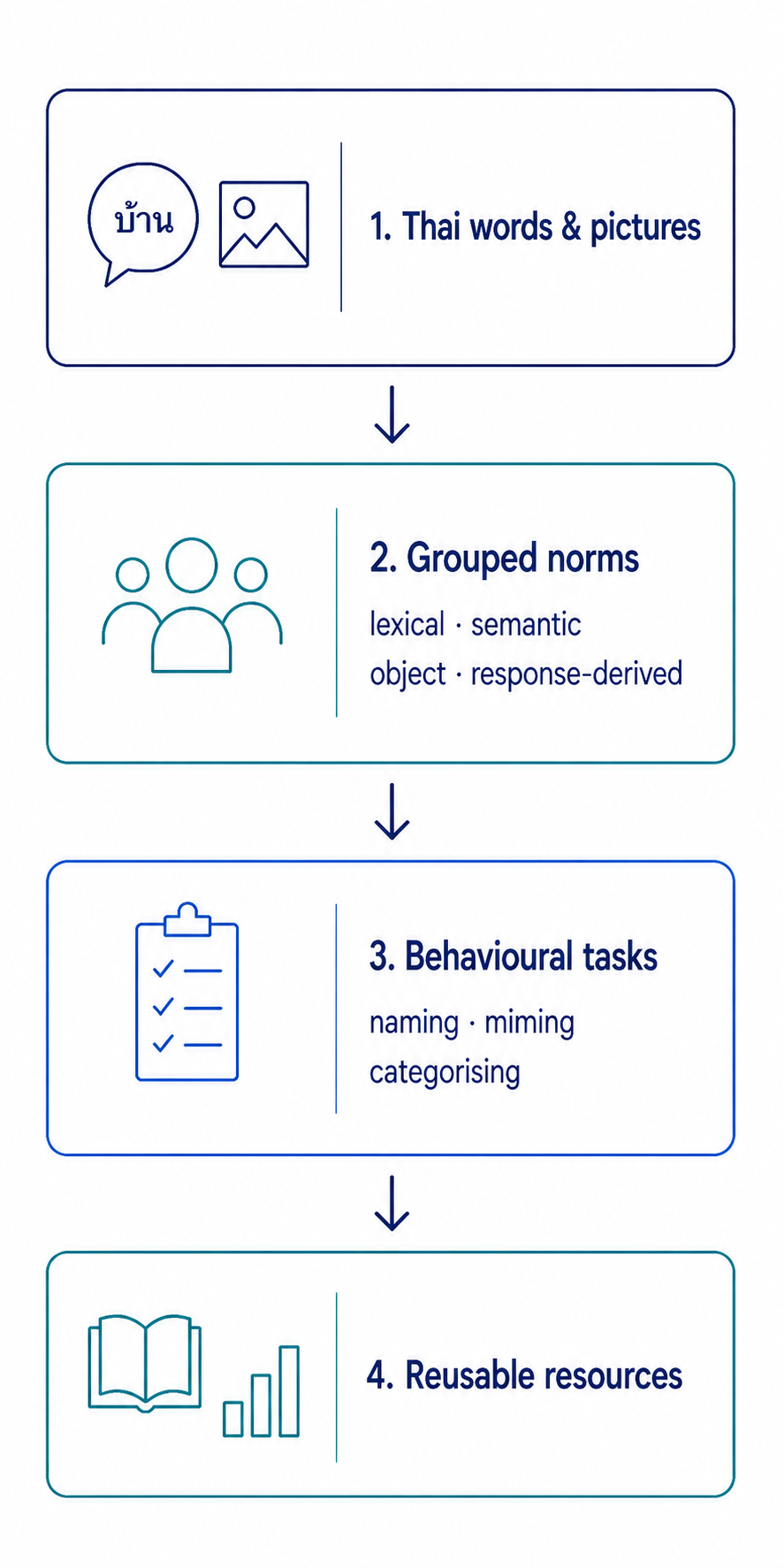
From norms to behavioural experiments
Norms are widely used to select and match research materials, but they can also be used to predict behavioural performance. The following three studies examine whether normed item properties help explain behaviour across different experimental tasks. Together, they illustrate how behavioural evidence can help validate the usefulness of psycholinguistic norms.
Different tasks need not produce identical patterns of predictors because each places different demands on lexical, conceptual, and action-related information.
Picture naming
A speeded picture-naming study examined whether the Thai object norms could predict variation in lexical retrieval (Clarke, unpublished data). Thai speakers named a controlled subset of 332 photographs, and the item-level properties accounted for a substantial proportion of the variation in naming times. Participants named pictures more quickly when their names were more consistently agreed upon, their referents were more familiar, and their names had been acquired earlier. Rated ease of pantomiming also made a smaller independent contribution, suggesting that action-related knowledge may contribute to object naming even when no physical action is required. This study provides behavioural validation of the resource: the normed properties do not merely describe the photographs but help explain how efficiently Thai speakers retrieve their names.
Mime initiation latency
Our mime-initiation study (Ludington & Clarke, 2026) measured the time participants took to begin an object-related action. Thai participants viewed photographs of objects and pantomimed each object’s typical use. Mime initiation latency (MIL) measured the time from picture onset to the onset of movement. Across 189 objects, mimeability and manipulability were the strongest independent predictors of initiation time. The psycholinguistic variables that correlated with MIL did not explain additional variance once these two action-related predictors had been considered, while visual complexity showed no reliable relationship with MIL. MIL is therefore best understood as a behavioural window onto access to action-related knowledge and the planning and initiation of an object-related response, rather than as a direct measure of semantic representation.
Semantic categorisation
In a recent semantic-categorisation study, currently under review, participants completed a speeded semantic-categorisation task involving 324 Thai words, deciding whether each word could easily evoke a mental image. In the final regression model, imageability, BOI, and age of acquisition each explained unique variation in response latency. Subjective frequency predicted response times in earlier models but did not contribute independently once age of acquisition was included.
This does not make frequency unimportant; it indicates that, for this task and item set, part of its predictive contribution overlapped with age of acquisition.
Taken together, these studies illustrate how different behavioural tasks can emphasise different aspects of lexical, conceptual, and action-related knowledge. In the present studies, picture naming was especially sensitive to lexical accessibility, conceptual familiarity, and age of acquisition; mime initiation placed greater weight on action-related object knowledge; and semantic categorisation revealed independent effects of imageability, sensorimotor grounding, and acquisition history.
The value of these tasks lies in their partly overlapping but task-sensitive patterns of results, rather than in producing the same finding three times.
Picture naming
Key predictors
Name Agreement · Object Familiarity · Age of Acquisition
Mimeability made a smaller independent contribution.
Mime initiation
Strongest predictors
Mimeability · Manipulability
Psycholinguistic variables did not explain additional variance.
Semantic categorisation
Independent predictors
Imageability · Body-Object Interaction · Age of Acquisition
Frequency overlapped with age of acquisition in the final model.
Why connected resources are more valuable than isolated datasets
An individual normative dataset can be valuable in its own right. A connected set of resources, however, creates additional possibilities because the same items can be characterised across several dimensions and reused across studies. Researchers can select suitable materials, match experimental conditions more carefully, control potential confounds, and model item-level variation with greater precision.
Consider a study comparing words with higher and lower body-object interaction (BOI). Without multiple norms for the same words, the two sets might also differ unintentionally in imageability, frequency, or age of acquisition. A multidimensional resource allows those properties to be matched or controlled statistically, making the interpretation of any observed BOI effect more defensible. The same logic applies when selecting object photographs for naming, action, or categorisation tasks.
Using the same stimuli across studies also allows evidence to accumulate around the same items over time. New measures can be added to established resources, behavioural findings can be interpreted alongside earlier norming data, and the same materials can be reused across different tasks. Rather than creating isolated datasets, this approach gradually builds a more complete picture of the properties and behaviour of the same words and objects.
Thai-language data also broaden the evidence base on which psycholinguistic claims are evaluated. The purpose is not to present Thai as uniquely difficult or uniquely revealing. Rather, it is to test the generality and limits of models developed largely from English and other well-resourced languages, while creating the resources needed for well-controlled psycholinguistic research involving Thai.
Current limits and future development
A substantial set of resources is now in place, although they are at different stages of development. The Thai object norms and the MIL dataset are published and openly available. The lexical-norm study is under review, the broader lexical set is still being consolidated, and several extensions remain in development or at the planning stage. Some resources are already available for use, whereas others require further development and validation before public release.
The scope of the existing norms also needs to be considered. Thai-specific resources are not necessarily representative of every Thai-speaking population. The principal norming samples have consisted largely of university students, making them most appropriate for experimental research with similar populations. Their use with children, older adults, people from different educational backgrounds, or clinical populations may require additional sampling, validation, or population-specific norms.
One developing extension concerns age of acquisition. Existing ratings are based on adults’ retrospective estimates of when they learned a word. The CLP Lab is also developing a curriculum-derived objective AoA resource by tracing vocabulary through Thai primary-school textbooks. This provides an independent source of evidence and may eventually complement, rather than replace, retrospective ratings of AoA.
Other planned and developing additions include affective norms, measures of visual and orthographic complexity for written Thai, and orthographic and phonological neighbourhood measures. Each extension addresses a different part of the same broader aim: experimental materials should be characterised in ways that reflect the language, population, and task for which they are intended.
Accessing and citing the resources
The website’s Research Resources page provides the current record of publicly available materials, including repository links, licences, and associated publications.
The Thai norms for 480 colour object photographs are openly available through ReShare (dataset DOI: 10.5255/UKDA-SN-852500). The MIL dataset and supporting materials are openly available through the Open Science Framework (dataset DOI: 10.17605/OSF.IO/AYDRH). The lexical norms will be added to the Research Resources page once their publication status, documentation, and release arrangements permit.
Researchers should consult the licence attached to each dataset and cite the associated publication when the norms or methods are used in their own work. Questions about reuse, documentation, or possible collaboration can be submitted through the website contact form.
Conclusion
Taken together, the studies and resources discussed here show why stimulus selection in psycholinguistic research is rarely a neutral undertaking. The apparently simple choice between one word or picture and another involves lexical, experiential, conceptual, visual, and response-related properties that can alter performance. Translation can transfer a label or instruction, but it cannot establish how a stimulus is named, experienced, or processed within a different linguistic and cultural context.
Dedicated Thai psycholinguistic resources make these properties measurable. The existing object norms, action-related measures, and developing lexical resources provide a working foundation for controlled stimulus selection, behavioural research, and cross-linguistic comparison involving Thai. Their longer-term value will depend on careful documentation, appropriate interpretation, continued testing across tasks and populations, and responsible expansion as new resources become ready.